Who was Henry Whitehead?
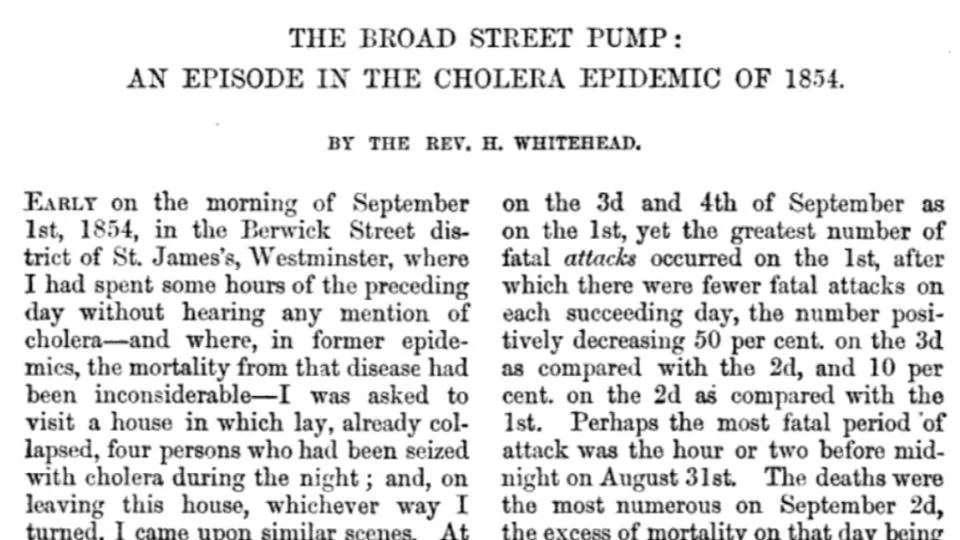
Henry Whitehead was a young curate at St. Luke’s Church in Soho during London’s 1854 cholera outbreak. He was a priest of the people, the kind of minister who made daily rounds of the neighborhood’s pubs and coffeehouses to talk with his parishioners. When hundreds of his flock fell ill and died within days, he tended the sick and also set out to understand what was killing them.
At first he was sure the physician John Snow was wrong. Whitehead accepted the prevailing theory of miasma, or poisoned air. So he did what an honest skeptic does: he gathered evidence. He took careful notes from conversations with his neighbors and studied the death records himself.
When local leaders formed a Vestry Committee to investigate, they appointed both Snow and Whitehead, and arguably no one worked harder than the curate. Going over the records late one night, he noticed a five-month-old, Frances Lewis, whose death came before the outbreak was thought to have begun. He knew the family. Her mother, Sarah, told him she had rinsed the baby’s soiled diapers and emptied the water into a cesspool a few feet from the Broad Street pump. A surveyor on the committee, Jehoshaphat York, excavated the cesspool and found it leaking into the well.
The facts persuaded Whitehead that Snow was right, and the “patient zero” he found completed the case. He matters because he shows that public health discovers the truth through community, not lone heroes.